Big models. Shared compute.

Turning independent AI nodes into a decentralized supercomputer.

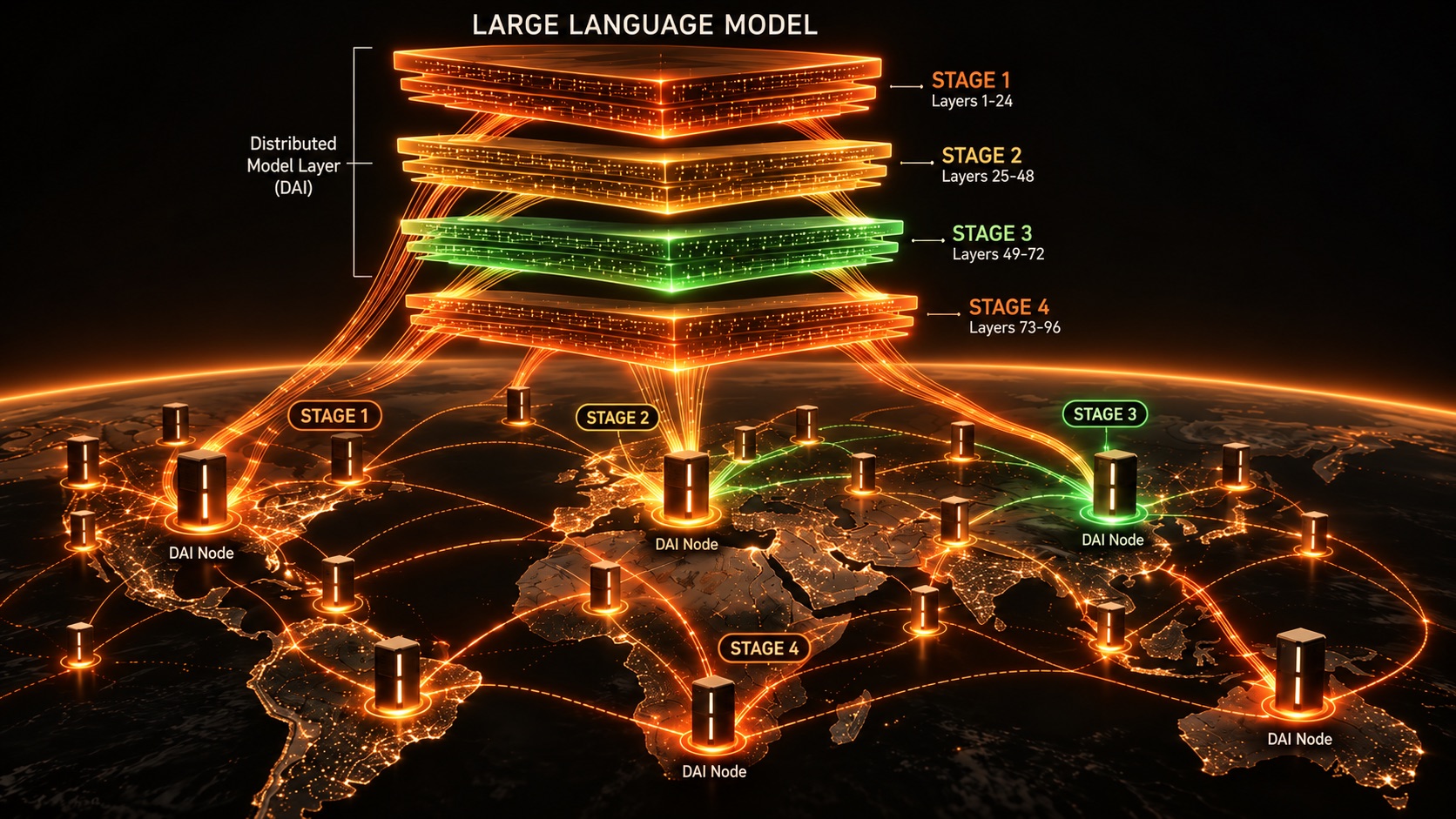
A large language model split into stages and served by DAI Nodes around the world

A single AI device has limited computing power and memory. But what if hundreds or thousands of independent devices could work together as one powerful AI system?

DAI is developing a technology that connects autonomous AI nodes into a decentralized supercomputer for running large language models, without relying on a central computing server.

How does it work?

One model. Many nodes. No central computing server.

A large language model consists of many layers. DAI-MESH divides the model into groups of layers and distributes them across multiple AI nodes.

Each node stores and processes its assigned part of the model, passing intermediate results to the next node through a peer-to-peer network.

Together, these nodes can execute models that would be too large for any single device.

As additional nodes join the network, they contribute memory and processing power. This allows DAI-MESH to scale its available computing resources and potentially support increasingly large AI models.

DAI-MESH is designed to operate without a central computing server. Nodes communicate directly through a peer-to-peer network.

If a node becomes unavailable, the network is designed to detect the failure and redirect workloads to other suitable nodes, restoring distributed execution when the required resources and model layers are available.

Not all nodes consume the same amount of energy or have the same computing capacity.

DAI-MESH takes computing performance, network conditions, node availability, and energy efficiency into account when distributing workloads.

Our FAST, BALANCED, and GREEN modes are designed to optimize execution for performance, cost, or energy consumption.

The network is designed to evaluate participating nodes based on their capabilities, availability, performance, and reliability.

Validation mechanisms and reputation scores help the system select suitable nodes, maintain network quality, and reduce dependence on unreliable participants.

From LUMI simulations to physical network tests.

We have already begun validating the foundations of DAI-MESH through large-scale simulations on the EuroHPC LUMI supercomputer.

In simulation, we study how hundreds or thousands of independent AI nodes can exchange data, synchronize state, recover from failures, and coordinate workloads without relying on a central computing server.

The next step is bringing this architecture into the physical world.

DAI-MESH offer

Work with top-tier AI models such as Kimi 3, Qwen3, and Mistral. Run AI agents and advanced reasoning tasks without worrying about high usage fees.

Shared distributed computing resources, energy-per-token optimization, and dedicated energy-saving modes can significantly reduce the cost per token and the overall cost of running AI workloads (up to 125× compared with traditional API-based inference).

Train and improve AI models across the DAI Network without sending your private data anywhere. Nodes share only what the model has learned, while sensitive data and processing can stay on your own device.

Run AI across a decentralized network or within private networks, while maintaining control over your data and infrastructure.

DAI distributes workloads across available nodes, adapting to network conditions and available energy resources.

Connect compatible hardware and help build a decentralized AI network and earn rewards by processing AI tasks, hosting model layers, and supporting other users.

Build with DAI

The next AI infrastructure is distributed.

Be among the first to test DAI-MESH.

Join our early-access program, explore distributed AI capabilities, and help shape the future of decentralized AI infrastructure.